# pino-pretty
[](https://www.npmjs.com/package/pino-pretty)
[](https://github.com/pinojs/pino-pretty/actions?query=workflow%3ACI)
[](https://coveralls.io/github/pinojs/pino-pretty?branch=master)
[](https://standardjs.com/)
This module provides a basic [ndjson](http://ndjson.org/) formatter to be used in __development__. If an
incoming line looks like it could be a log line from an ndjson logger, in
particular the [Pino](https://getpino.io/) logging library, then it will apply
extra formatting by considering things like the log level and timestamp.
A standard Pino log line like:
```
{"level":30,"time":1522431328992,"msg":"hello world","pid":42,"hostname":"foo","v":1}
```
Will format to:
```
[17:35:28.992] INFO (42): hello world
```
If you landed on this page due to the deprecation of the `prettyPrint` option
of `pino`, read the [Programmatic Integration](#integration) section.
## Example
Using the [example script][exscript] from the Pino module, we can see what the
prettified logs will look like:
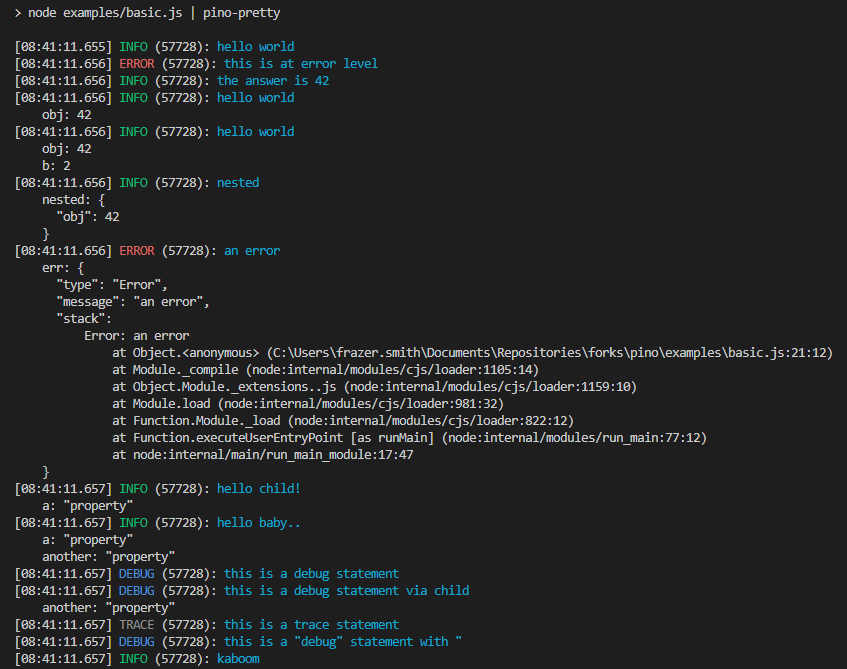
[exscript]: https://github.com/pinojs/pino/blob/25ba61f40ea5a1a753c85002812426d765da52a4/examples/basic.js
## Install
```sh
$ npm install -g pino-pretty
```
## Usage
It is recommended to use `pino-pretty` with `pino`
by piping output to the CLI tool:
```sh
node app.js | pino-pretty
```
### CLI Arguments
- `--colorize` (`-c`): Adds terminal color escape sequences to the output.
- `--colorizeObjects` (`-C`): Allows suppressing colorization of objects when set to `false`. In combination with `--singleLine`, this ensures that the end of each line is parsable JSON.
- `--crlf` (`-f`): Appends carriage return and line feed, instead of just a line
feed, to the formatted log line.
- `--errorProps` (`-e`): When formatting an error object, display this list
of properties. The list should be a comma-separated list of properties Default: `''`.
Do not use this option if logging from pino@7. Support will be removed from future verions.
- `--levelFirst` (`-l`): Display the log level name before the logged date and time.
- `--errorLikeObjectKeys` (`-k`): Define the log keys that are associated with
error like objects. Default: `err,error`.
- `--messageKey` (`-m`): Define the key that contains the main log message.
Default: `msg`.
- `--levelKey` (`--levelKey`): Define the key that contains the level of the log. Nested keys are supported with each property delimited by a dot character (`.`).
Keys may be escaped to target property names that contains the delimiter itself:
(`--levelKey tags\\.level`).
Default: `level`.
- `--levelLabel` (`-b`): Output the log level using the specified label.
Default: `levelLabel`.
- `--minimumLevel` (`-L`): Hide messages below the specified log level. Accepts a number, `trace`, `debug`, `info`, `warn`, `error`, or `fatal`. If any more filtering is required, consider using [`jq`](https://stedolan.github.io/jq/).
- `--customLevels` (`-x`): Override default levels with custom levels, e.g. `-x err:99,info:1`
- `--customColors` (`-X`): Override default colors with custom colors, e.g. `-X err:red,info:blue`
- `--useOnlyCustomProps` (`-U`): Only use custom levels and colors (if provided) (default: true); else fallback to default levels and colors, e.g. `-U false`
- `--messageFormat` (`-o`): Format output of message, e.g. `{levelLabel} - {pid} - url:{req.url}` will output message: `INFO - 1123 - url:localhost:3000/test`
Default: `false`
- `--timestampKey` (`-a`): Define the key that contains the log timestamp.
Default: `time`.
- `--translateTime` (`-t`): Translate the epoch time value into a human-readable
date and time string. This flag also can set the format string to apply when
translating the date to a human-readable format. For a list of available pattern
letters, see the [`dateformat` documentation](https://www.npmjs.com/package/dateformat).
- The default format is `HH:MM:ss.l` in the local timezone.
- Require a `UTC:` prefix to translate time to UTC, e.g. `UTC:yyyy-mm-dd HH:MM:ss.l o`.
- Require a `SYS:` prefix to translate time to the local system's time zone. A
shortcut `SYS:standard` to translate time to `yyyy-mm-dd HH:MM:ss.l o` in
system time zone.
- `--ignore` (`-i`): Ignore one or several keys, nested keys are supported with each property delimited by a dot character (`.`),
keys may be escaped to target property names that contains the delimiter itself:
(`-i time,hostname,req.headers,log\\.domain\\.corp/foo`).
The `--ignore` option would be ignored, if both `--ignore` and `--include` are passed.
Default: `hostname`.
- `--include` (`-I`): The opposite of `--ignore`. Include one or several keys.
- `--hideObject` (`-H`): Hide objects from output (but not error object)
- `--singleLine` (`-S`): Print each log message on a single line (errors will still be multi-line)
- `--config`: Specify a path to a config file containing the pino-pretty options. pino-pretty will attempt to read from a `.pino-prettyrc` in your current directory (`process.cwd`) if not specified
## Programmatic Integration
We recommend against using `pino-pretty` in production and highly
recommend installing `pino-pretty` as a development dependency.
Install `pino-pretty` alongside `pino` and set the transport target to `'pino-pretty'`:
```js
const pino = require('pino')
const logger = pino({
transport: {
target: 'pino-pretty'
},
})
logger.info('hi')
```
The transport option can also have an options object containing `pino-pretty` options:
```js
const pino = require('pino')
const logger = pino({
transport: {
target: 'pino-pretty',
options: {
colorize: true
}
}
})
logger.info('hi')
```
Use it as a stream:
```js
const pino = require('pino')
const pretty = require('pino-pretty')
const logger = pino(pretty())
logger.info('hi')
```
Options are also supported:
```js
const pino = require('pino')
const pretty = require('pino-pretty')
const stream = pretty({
colorize: true
})
const logger = pino(stream)
logger.info('hi')
```
See the [Options](#options) section for all possible options.
### Usage as a stream
If you are using `pino-pretty` as a stream and you need to provide options to `pino`,
pass the options as the first argument and `pino-pretty` as second argument:
```js
const pino = require('pino')
const pretty = require('pino-pretty')
const stream = pretty({
colorize: true
})
const logger = pino({ level: 'info' }, stream)
// Nothing is printed
logger.debug('hi')
```
### Usage with Jest
Logging with Jest is _problematic_, as the test framework requires no asynchronous operation to
continue after the test has finished. The following is the only supported way to use this module
with Jest:
```js
import pino from 'pino'
import pretty from 'pino-pretty'
test('test pino-pretty', () => {
const logger = pino(pretty({ sync: true }));
logger.info('Info');
logger.error('Error');
});
```
### Handling non-serializable options
Using the new [pino v7+
transports](https://getpino.io/#/docs/transports?id=v7-transports) not all
options are serializable, for example if you want to use `messageFormat` as a
function you will need to wrap `pino-pretty` in a custom module.
Executing `main.js` below will log a colorized `hello world` message using a
custom function `messageFormat`:
```js
// main.js
const pino = require('pino')
const logger = pino({
transport: {
target: './pino-pretty-transport',
options: {
colorize: true
}
},
})
logger.info('world')
```
```js
// pino-pretty-transport.js
module.exports = opts => require('pino-pretty')({
...opts,
messageFormat: (log, messageKey) => `hello ${log[messageKey]}`
})
```
### Options
The options accepted have keys corresponding to the options described in [CLI Arguments](#cliargs):
```js
{
colorize: colorette.isColorSupported, // --colorize
colorizeObjects: true, //--colorizeObjects
crlf: false, // --crlf
errorLikeObjectKeys: ['err', 'error'], // --errorLikeObjectKeys
errorProps: '', // --errorProps
levelFirst: false, // --levelFirst
messageKey: 'msg', // --messageKey
levelKey: 'level', // --levelKey
messageFormat: false, // --messageFormat
timestampKey: 'time', // --timestampKey
translateTime: false, // --translateTime
ignore: 'pid,hostname', // --ignore
include: 'level,time', // --include
hideObject: false, // --hideObject
singleLine: false, // --singleLine
customColors: 'err:red,info:blue', // --customColors
customLevels: 'err:99,info:1', // --customLevels
levelLabel: 'levelLabel', // --levelLabel
minimumLevel: 'info', // --minimumLevel
useOnlyCustomProps: true, // --useOnlyCustomProps
// The file or file descriptor (1 is stdout) to write to
destination: 1,
// Alternatively, pass a `sonic-boom` instance (allowing more flexibility):
// destination: new SonicBoom({ dest: 'a/file', mkdir: true })
// You can also configure some SonicBoom options directly
sync: false, // by default we write asynchronously
append: true, // the file is opened with the 'a' flag
mkdir: true, // create the target destination
customPrettifiers: {}
}
```
The `colorize` default follows
[`colorette.isColorSupported`](https://github.com/jorgebucaran/colorette#iscolorsupported).
The defaults for `sync`, `append`, `mkdir` inherit from
[`SonicBoom(opts)`](https://github.com/pinojs/sonic-boom#API).
`customPrettifiers` option provides the ability to add a custom prettify function
for specific log properties. `customPrettifiers` is an object, where keys are
log properties that will be prettified and value is the prettify function itself.
For example, if a log line contains a `query` property,
you can specify a prettifier for it:
```js
{
customPrettifiers: {
query: prettifyQuery
}
}
//...
const prettifyQuery = value => {
// do some prettify magic
}
```
Additionally, `customPrettifiers` can be used to format the `time`, `hostname`,
`pid`, `name`, `caller` and `level` outputs:
```js
{
customPrettifiers: {
// The argument for this function will be the same
// string that's at the start of the log-line by default:
time: timestamp => `🕰 ${timestamp}`,
// The argument for the level-prettifier may vary depending
// on if the levelKey option is used or not.
// By default this will be the same numerics as the Pino default:
level: logLevel => `LEVEL: ${logLevel}`,
// other prettifiers can be used for the other keys if needed, for example
hostname: hostname => colorGreen(hostname),
pid: pid => colorRed(pid),
name: name => colorBlue(name),
caller: caller => colorCyan(caller)
}
}
```
Note that prettifiers do not include any coloring, if the stock coloring on
`level` is desired, it can be accomplished using the following:
```js
const { colorizerFactory } = require('pino-pretty')
const levelColorize = colorizerFactory(true)
const levelPrettifier = logLevel => `LEVEL: ${levelColorize(logLevel)}`
//...
{
customPrettifiers: { level: levelPrettifier }
}
```
`messageFormat` option allows you to customize the message output.
A template `string` like this can define the format:
```js
{
messageFormat: '{levelLabel} - {pid} - url:{req.url}'
}
```
In addition to this, if / end statement blocks can also be specified.
Else statements and nested conditions are not supported.
```js
{
messageFormat: '{levelLabel} - {if pid}{pid} - {end}url:{req.url}'
}
```
This option can also be defined as a `function` with this prototype:
```js
{
messageFormat: (log, messageKey, levelLabel) => {
// do some log message customization
return customized_message;
}
}
```
## Limitations
Because `pino-pretty` uses stdout redirection, in some cases the command may
terminate with an error due to shell limitations.
For example, currently, mingw64 based shells (e.g. Bash as supplied by [git for
Windows](https://gitforwindows.org)) are affected and terminate the process with
a `stdout is not a tty` error message.
Any PRs are welcomed!
## License
MIT License